
Thilafushi:By the Late 1990s,11.1 hectares. Leased and a Million-Dollar Return

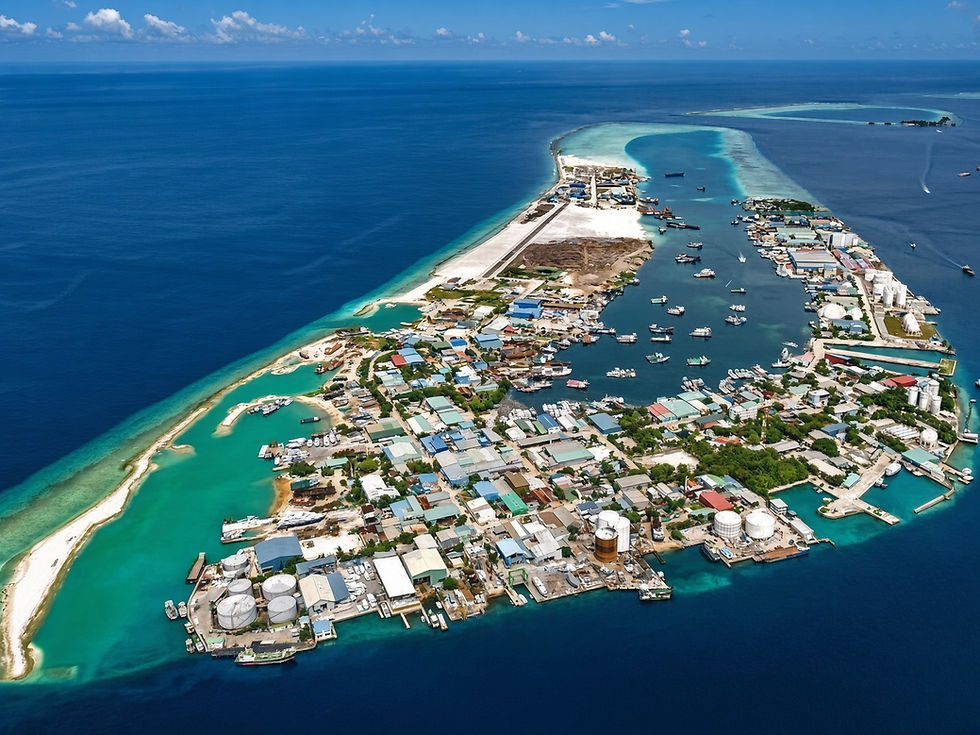
Thilafushi began as a lagoon, not an island. Known as Thilafalhu, it stretched roughly seven kilometers in length and narrowed to about two hundred meters at its shallowest points-a strip of reef flat and shallow water west of Malé, lying between Giraavaru and Gulhifalhu in Kaafu Atoll. It held no permanent dry land. A simple rectangle of those dimensions would cover about 1.4 square kilometers, but the lagoon was not a uniform rectangle, so that figure is only an upper-bound sketch of the shallow zone, not a surveyed area of land. Until Malé’s waste problem forced a decision, the site served no settled purpose at all.
Through the late 1980s and early 1990s, the capital and the growing resort sector produced more garbage than the country’s small, low-lying islands could absorb. A severe storm surge in 1987 scattered accumulated trash across coasts and beaches, making the shortage of disposal space impossible to ignore. After a series of discussions, the government decided on 5 December 1991 to reclaim Thilafalhu as a municipal landfill. The site received its first load of garbage from Malé on 7 January 1992.
The first operations were small and direct. Work started with one landing craft, four heavy trucks, two excavators, and a single wheel loader. Crews dug pits, called cells, each about 37,500 cubic feet (1,060 cubic meters). Sand taken from the excavation was used to build walled enclosures around the inner perimeter. Unsorted waste was dumped into the pits, covered with a layer of construction debris, and leveled with white sand. Segregation was not attempted at the start; the volume arriving each day had to be buried immediately.
That daily volume drove the change from water to land. Inflows commonly reached several hundred tons-often cited in the range of 330 to 800 tons-so the filled cells advanced faster than any formal plan. For years the new ground was reported to grow by about one square meter a day. What had been open lagoon became a measurable landmass. By the late 1990s the reclaimed area was large enough for other uses. In November 1997 the government began leasing plots to industrial tenants. Leaseholders increased from an initial 22 to 54, occupying more than 1.2 million square feet (about 0.11 square kilometers, or 27.5 acres). Those leases were reported to generate more than 14 million rufiyaa a year, roughly one million U.S. dollars at contemporary rates. Boat building, cement packing, gas bottling, and warehousing took hold on the firmer ground. An additional section of about 0.2 square kilometers, later called Thilafushi-2, was filled with white sand for heavier industry. Accounts from this period placed the overall landmass above 4.6 million square feet, or about 0.43 square kilometers-roughly 43 hectares, or about 106 acres.
Later growth has come from both continued waste deposition and engineered reclamation, which is why no single official total exists. Surveys have placed the island between roughly 0.4 and 1 square kilometer, depending on the year and the boundary used. Separate project works add blocks that are not always folded into the older figure: 15 hectares reclaimed in 2018 for waste facilities, and about 120 hectares completed in 2024 in areas A, B, E, and F of Thilafushi phase two. Port plans on the same island allocate on the order of 20 to 60 hectares for a new commercial harbour, depending on the phase described. Revenue has shifted with the land. Early income came mainly from industrial leases. Resort waste delivered directly to the island now carries a tipping fee. A waste-to-energy plant designed to handle about 500 tons a day is intended to add sales of electricity, recovered metals, and bottom ash, though operating costs are expected to require public support in the early years.
The lagoon that existed before December 1991 no longer appears on the chart. In its place is an artificial island whose earlier waste-and-industry mass is commonly quoted at about 0.43 square kilometers, with later sand fill-especially the 120-hectare phase-two block-pushing the developed area well beyond that older total. Thilafushi’s history is the record of a 7-kilometer shallow lagoon converted, load by load and then project by project, into both a disposal site and an industrial landmass.


Comments