
The Abyssinian/Habshigefaanu Magaam and the Kurendhoo Loi Ziyaraiy: Monuments to a Pious Wanderer
- Ibrahim Rasheed
- May 18
- 5 min read


Habshigefaanu, also known as Shaykh al-Hafiz Yusuf Najibul Habshi, Shaykh Najib, or Shaykh Najib al-Habashi al-Salih, stands as one of the most revered figures in Maldivian Islamic tradition. Believed to be of Abyssinian (Habshi/Ethiopian or broader East African) origin, he is remembered as a pious scholar, trader, and missionary who traversed the Maldive Archipelago in the medieval period, helping to deepen the roots of Islam after the islands’ official conversion around 1153 CE. His legacy endures through two key sites: the Habshigefaanu Magaam (Shrine of the African Worthy) in Malé, a memorial monument, and his traditional final resting place at the Kurendhoo Ziyarat in Faadhippolhu (Lhaviyani) Atoll.
Arrival and Missionary Life in the Maldives
Maldivian oral traditions and chronicles (Ta’rikh) portray Shaykh Najib as a seafaring trader who arrived on a ship from the Horn of Africa. He settled temporarily in Malé, where he became known for his beautiful Qur’an recitation, teaching, and devout nightly prayers (tahajjud or rey alhukan). Unlike ordinary merchants, he avoided fishing and was associated with numerous karamaiy (miracles), leading locals to regard him as a wali (saint).
His missionary journeys took him across the atolls to strengthen Islamic faith and practice. Tradition holds that he eventually reached Kurendhoo Island, where he passed away. One detailed account describes his arrival on the island as an unknown stranger. While performing ablution, he noticed a luminous spot among the trees, climbed a coconut tree, and later died that night. The islanders buried him on the spot, which became the foundation of the Kurendhoo Ziyarat.
Ibn Battuta’s Eyewitness Account (1343–1346)
The earliest written reference to Shaykh Najib comes from the famous Moroccan traveler Ibn Battuta, who visited the Maldives in 1343–1344 and again in 1346. Shortly after arriving in Malé, Ibn Battuta visited a hermitage at the southeastern extremity of the island. He recorded going there the day after his arrival, accompanied by the qadi of Malé, Manikufaanu Isa al-Yamani, and the boat captain:
“The next morning I left with the head of the boat and the qadi Ica Alyamany to visit a hermitage situated at the extreme end of the island and founded by the virtuous Sheikh Nedjib ”
Ibn Battuta described Shaykh Najib positively as a virtuous founder of the hermitage but gave no extensive biography. Historians identify this site as the precursor to the later Habshigefaanu Magaam. His account confirms that veneration of the saint was already established by the mid-14th century, placing Shaykh Najib’s activity in the early-to-mid 1300s (after 1153 and likely before the 1340s).
The Habshigefaanu Magaam in Malé
The formal monument known as the Habshigefaanu Magaam (“Shrine of the African Worthy” or “Shrine of the Habshi Saint”) was not the saint’s tomb but a memorial erected at the site of his devotions in Malé. It stood in the precincts of Lonu Ziyaaraiy Kolhu (Lonu Ziyaraiy), a historically sacred area in the south-eastern part of the capital.
The shrine was constructed during the short reign of Sultan Mukarram Muhammad Imaduddin III (1750–1752 CE) specifically at the location where Shaykh Najib was believed to have performed his night prayers. Later enhancements, including lamps and coral-stone boundaries, occurred under other sultans, sometimes linked to royal vows for protection against threats like Malabari raiders. The site became a focal point of local veneration, part of broader commemorative practices alongside other saints and martyr-kings.
Tragically, the Lonu Ziyaaraiy complex, including the Habshigefaanu Magaam, was demolished in 1966 (October) amid shifting religious and urban developments in Malé. The area later evolved into other uses, including a park.
The Final Resting Place: Kurendhoo Ziyaraiy
While the Malé magaam served as a memorial, Kurendhoo Island in Faadhippolhu Atoll is traditionally accepted as Habshigefaanu’s actual burial place. The Kurendhoo Ziyarat developed around his grave, which locals discovered as the first burial site on the island. It became one of the most famous ziyarats in the Maldives, drawing pilgrims who sought blessings and took healing water from the site (known for its clarity and association with Teyyo Fen Fodhu rituals)
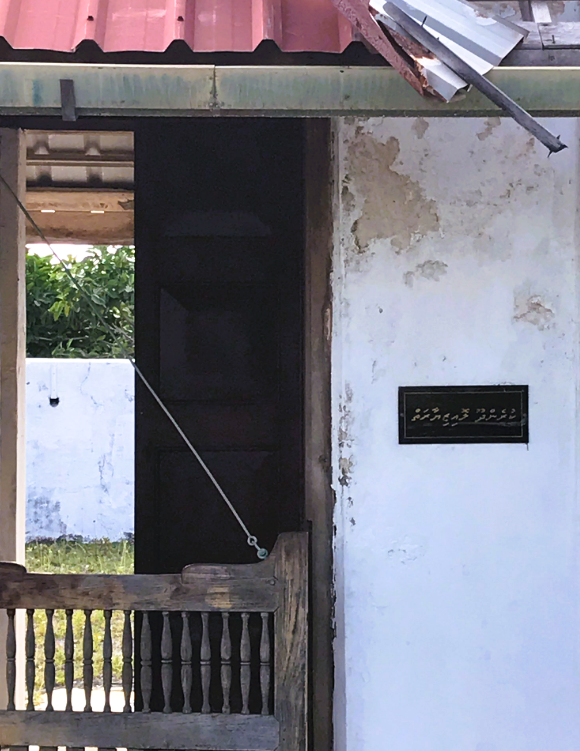


It is widely believed that he passed away on the 15th of Ramadan. The death anniversary (uru /Faathihaa) of Habshigefaanu is commemorated on this day in Kurendhoo and other islands in Faadhippolhu Atoll. This is a special day for these islands. The late Luthfy mentioned that on this day, 6 or 7 Bhastra (large storage bags) of rice are cooked, and the government also sends fat billy goat ” (special food provisions). The expenses for preparing the uru/ Faathihaa are covered by donations from visitors and those wishing to participate.
A mosque linked to the ziyaraiy was built in 986 AH (circa 1578 CE) by local residents. Renovations over centuries included building a small protective structure around the coral-stone grave. The island itself has ancient Buddhist roots, evidenced by stupa materials, highlighting the transition from pre-Islamic to Islamic sacred landscapes.
Historical and Cultural Significance
Long before European colonization, Africans crossed the Indian Ocean with the monsoon winds. Some rose to command armies. Some governed cities. Some built families whose descendants are still there today.
They are often called Siddis now, or Seedi, but their story is older than that name. Their presence is written into Indian Ocean maritime trade history, architecture, music, and memory.

This isn’t a secret history. It’s a forgotten one. The Habshi dynasty refers to the brief era of Siddi (referred to at the time as Habesha) rulers in Bengal that lasted from 1487 to 1493 during the Bengal Sultanate. Four Habshi rulers ruled Bengal during this period.
The Siddi (or Abyssinian) culture of the Indian Ocean is a striking syncretic blend of East African and Sufi traditions. The integration of the African diaspora into the spiritual fabric of the Indian subcontinent represents an important cross-cultural phenomenon.
Shaykh Yusuf Najibul Habshi’s story fits squarely into this broader, often overlooked African presence across the Indian Ocean world. The Maldives, with their strategic position on ancient trade routes, attracted scholars, traders, and settlers from the Horn of Africa and the Swahili coast. Habshigefaanu exemplifies the contributions of such figures not only to trade but to Islamic scholarship, education, and spiritual life.
The dual sites , the memorial magaam in the capital and the tomb on Kurendhoo , illustrate how Maldivian devotion layered royal patronage, oral history, and folk piety across centuries. Though physical structures like the Malé magaam no longer stand, the traditions persist in Maldivian Ta’rikh chronicles, local scholarship (e.g., works by Muhammad Ibrahim Luthfy), and cultural memory. They remind us of a shared heritage blending African, Arab, South Asian, and indigenous elements in one of the world’s most unique Islamic societies.
In an era of rapid modernization, the legacy of Shaykh Yusuf Najibul Habshi continues to symbolize the deep spiritual foundations of Maldivian identity , rooted in the travels of a pious Abyssinian who found his way across the seas to these coral islands.


Comments